Release risk
Code defects, dependency issues and insufficient separation between testing and production made releases harder to manage.


FoxMarketeer connected application stability, local search and patient journeys across Madhavbaug’s web and mobile ecosystem.
Explore the work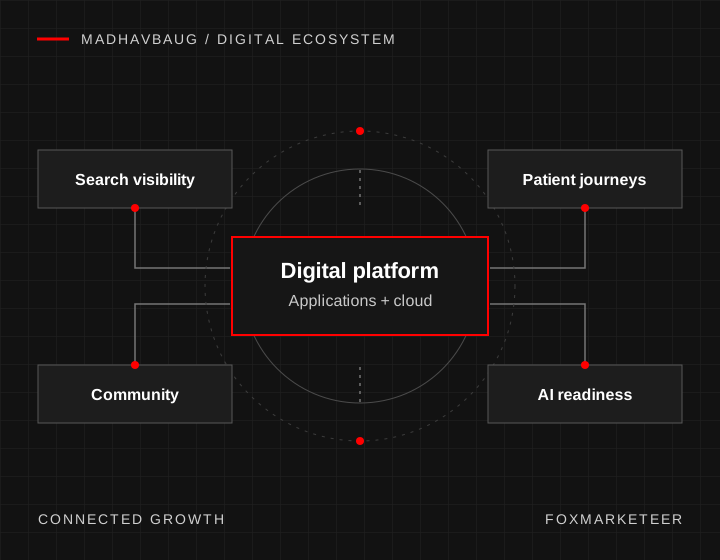
Scope figures describe the work. Performance measures are listed separately below.
Madhavbaug’s digital estate served patients looking for treatments, doctors and clinics. Application defects, release risk and fragmented patient journeys made it harder to support that demand reliably.
Code defects, dependency issues and insufficient separation between testing and production made releases harder to manage.
Crawl errors, broken URLs and inconsistent structured data complicated search visibility across clinics, doctors and treatments.
Inconsistent appointment prompts and a lack of structured community content limited how patients could find answers and take the next step.
Review architecture, defects, search and patient journeys.
Remediate defects and establish controlled release environments.
Improve technical SEO, local pages and content structure.
Improve page performance, navigation and appointment pathways.
Build community architecture and structure data for future analysis.
The programme brought development, DevOps, design, SEO and analytics together, with client stakeholders responsible for medical validation, infrastructure approvals and acceptance testing.
Reviewed architecture, repositories, dependencies and environment configuration across React, FastAPI, MongoDB and Expo React Native. Prioritised defects by severity and addressed issues in APIs, database interactions, authentication, web interfaces and mobile journeys.
Delivered Health checks, hotfix procedures and post-release monitoring to give the team clearer visibility into release readiness.
Set up separate development and staging environments for user acceptance, regression and smoke testing. Used Docker and Kubernetes to support repeatable builds and deployment workflows. Coordinated cloud migration and mobile packaging for Android and iOS.
Delivered A release runbook covering configuration, validation, operational ownership and rollback.
Investigated crawl and indexing issues in Google Search Console. Addressed sitemap warnings, broken links, obsolete URLs, canonicals and mobile usability. Standardised metadata, headings, image alt text and internal linking across page groups.
Delivered Local and clinic structured data, a review of FAQ and video markup, and a medical author attribution system with author and reviewer credentials.
Introduced WebP, compression, lazy loading, deferred JavaScript, CSS optimisation and CDN asset delivery. Reviewed LCP, CLS and INP to identify front-end bottlenecks.
To Be Validated Changes in load times and Core Web Vitals against pre- and post-implementation reports.
Restructured the homepage around treatments, clinics and doctors. Reviewed or redesigned more than 20 treatment pages to improve information hierarchy, medical attribution and appointment prompts. Refined clinic pages around local information, maps and enquiry options.
To Be Validated Enquiry and appointment conversion changes through analytics and CRM data.
Built a three-level forum with a community landing page, topic categories and individual question-and-answer threads. The structure was designed to surface recurring questions and inform future educational content.
Governance Moderation, consent, privacy and clinical review require approved client policies and accountable owners.
Structured relevant FastAPI and MongoDB data flows for future analysis of recurring questions, content gaps and engagement patterns.
Potential next phase Explore topic classification, FAQ suggestions and educational content recommendations after privacy, medical governance and technical validation.
Validate baselines and post-launch data with the client’s technical, SEO and analytics teams.
Start with the systems, journeys and outcomes that matter most to your business.